MLKQUOTES.SITE

Quotes by theme

MLK quotes on love

King’s best-known words on love are “Darkness cannot drive out darkness; only light can do that. Hate cannot drive out hate; only love can do that,” from his 1963 sermon collection Strength to Love. For King, love wasn’t a feeling. It was agape, which he defined as “understanding, creative, redemptive goodwill for all men,” and it was the engine of his nonviolent method.

Love quotes

Tap an image to open it full size. Use the buttons to save it to Pinterest, share it, or download it.

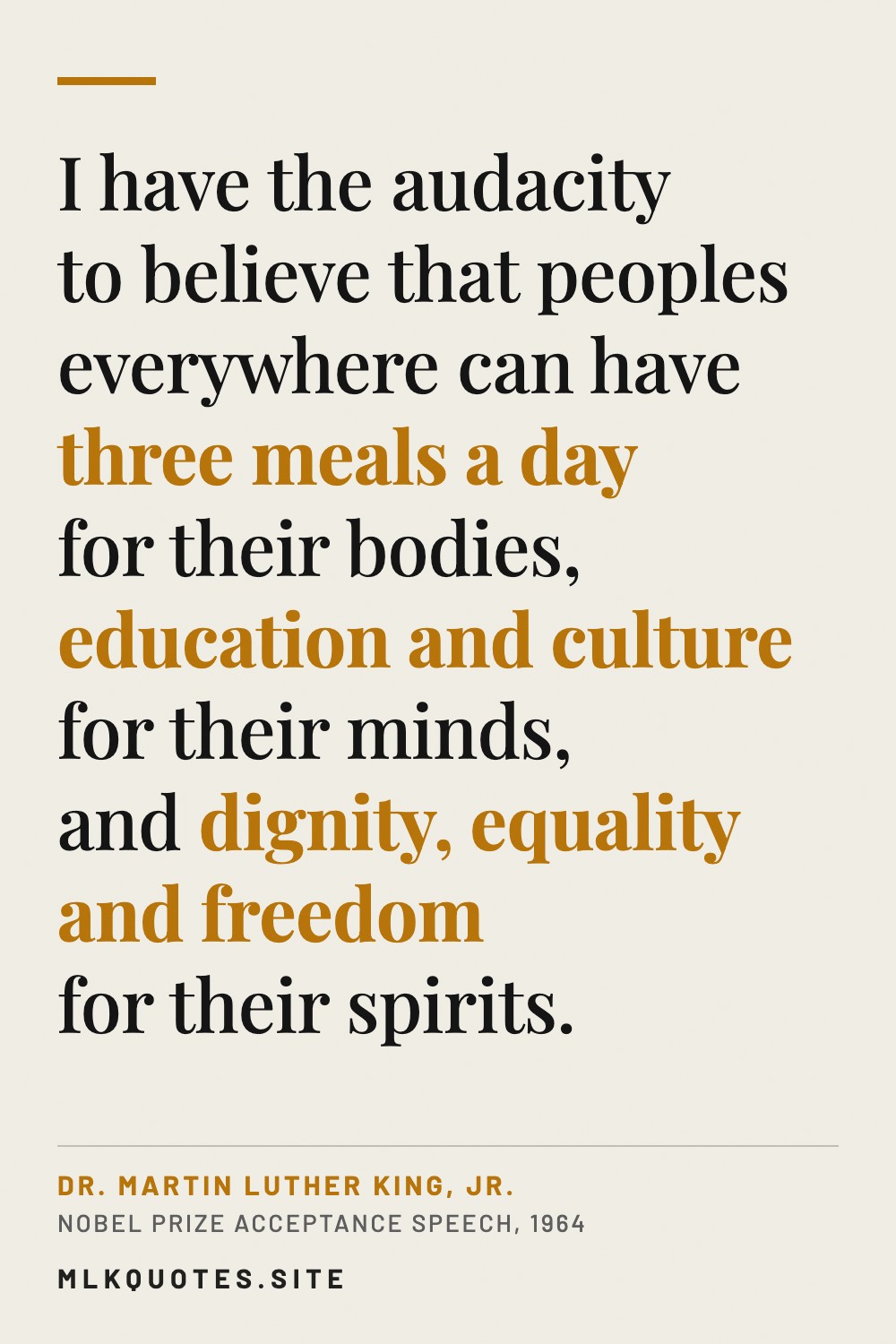
Quote image: “I have the audacity to believe that peoples everywhere can have three meals a day for their bodies, education and culture for their minds, and dignity, equality and freedom for their spirits.” Martin Luther King Jr., Nobel Prize acceptance speech, 1964.

“I have the audacity to believe that peoples everywhere can have three meals a day for their bodies, education and culture for their minds, and dignity, equality and freedom for their spirits.”

Nobel Prize acceptance speech, 1964

Save
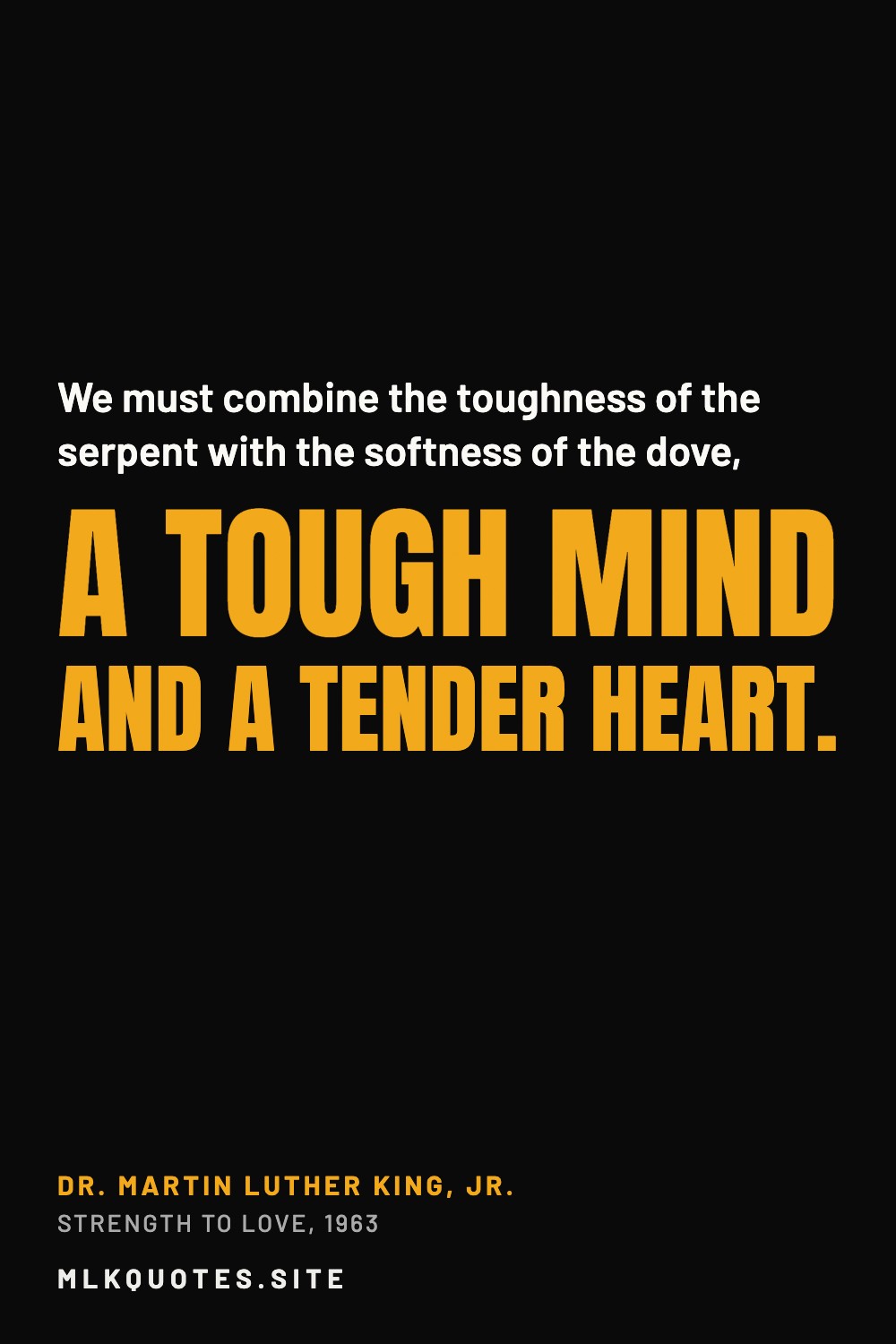
Quote image: “We must combine the toughness of the serpent with the softness of the dove, a tough mind and a tender heart.” Martin Luther King Jr., Strength to Love, 1963.

“We must combine the toughness of the serpent with the softness of the dove, a tough mind and a tender heart.”

Strength to Love, 1963

Save
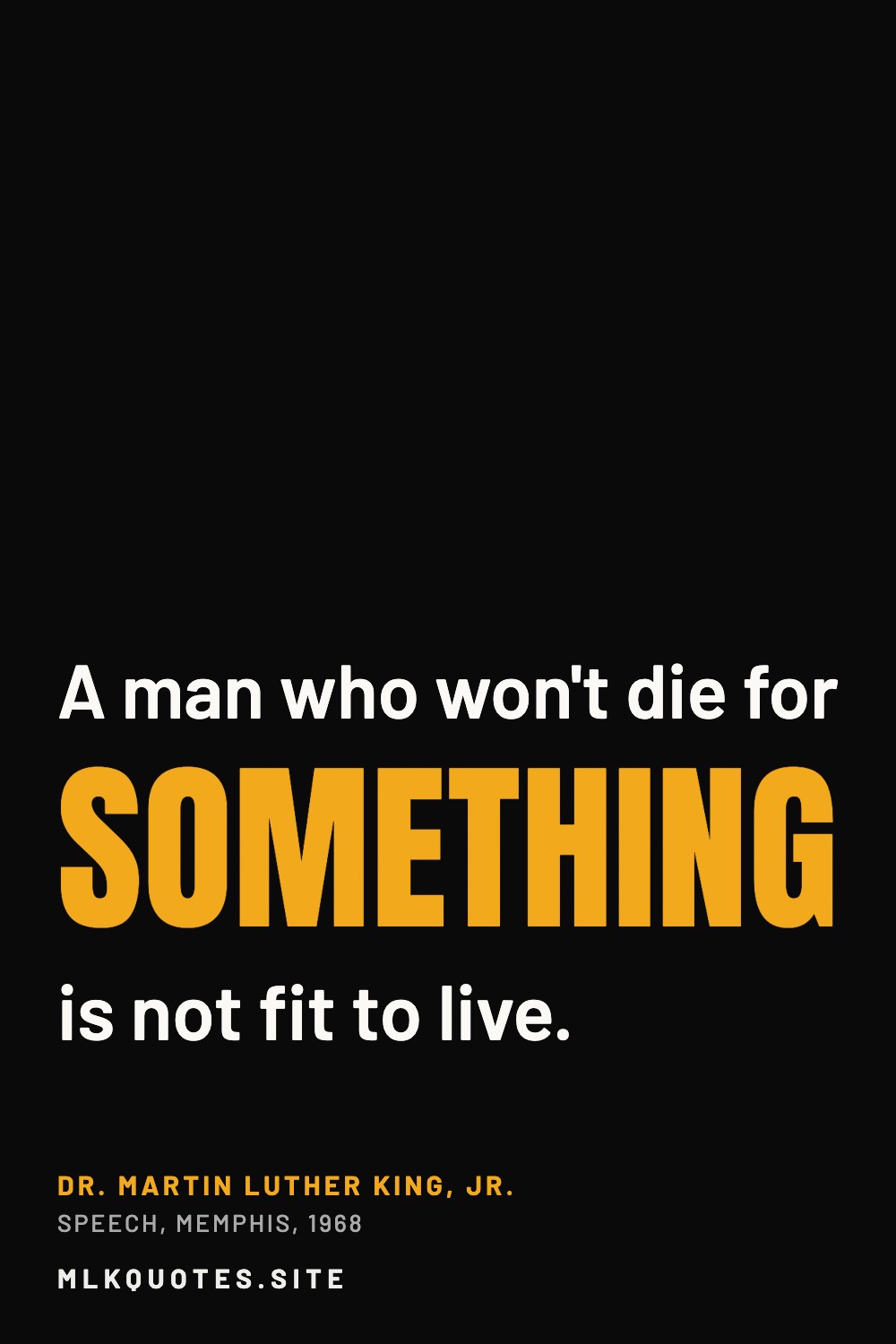
Quote image: “A man who won't die for something is not fit to live.” Martin Luther King Jr., Speech, Memphis, 1968.

“A man who won't die for something is not fit to live.”

Speech, Memphis, 1968

Save
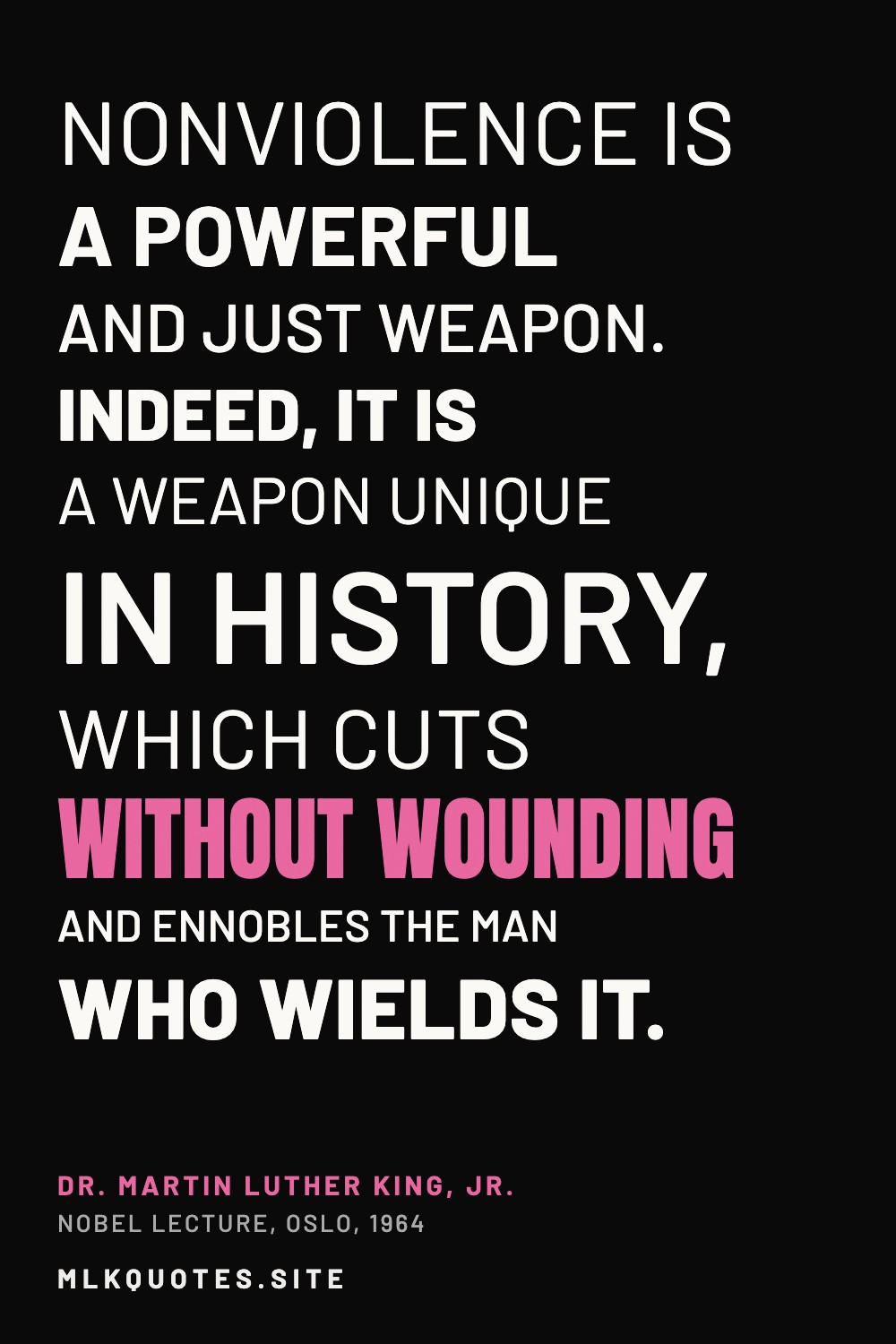
Quote image: “Nonviolence is a powerful and just weapon. Indeed, it is a weapon unique in history, which cuts without wounding and ennobles the man who wields it.” Martin Luther King Jr., Nobel lecture, Oslo, 1964.

“Nonviolence is a powerful and just weapon. Indeed, it is a weapon unique in history, which cuts without wounding and ennobles the man who wields it.”

Nobel lecture, Oslo, 1964

Save
Quote image: “Nonviolence means avoiding not only external physical violence but also internal violence of spirit.” Martin Luther King Jr., Stride Toward Freedom, 1958.

“Nonviolence means avoiding not only external physical violence but also internal violence of spirit.”

Stride Toward Freedom, 1958

Save
Quote image: “Forgiveness is not an occasional act, it is a permanent attitude.” Martin Luther King Jr., Strength to Love, 1963.

“Forgiveness is not an occasional act, it is a permanent attitude.”

Strength to Love, 1963

Save
Quote image: “Life's most persistent and urgent question is, what are you doing for others?” Martin Luther King Jr., Speech, 1957.

“Life's most persistent and urgent question is, what are you doing for others?”

Speech, 1957

Save
Quote image: “The chain reaction of evil, hate begetting hate, wars producing more wars, must be broken, or we shall be plunged into the dark abyss of annihilation.” Martin Luther King Jr., Strength to Love, 1963.

“The chain reaction of evil, hate begetting hate, wars producing more wars, must be broken, or we shall be plunged into the dark abyss of annihilation.”

Strength to Love, 1963

Save
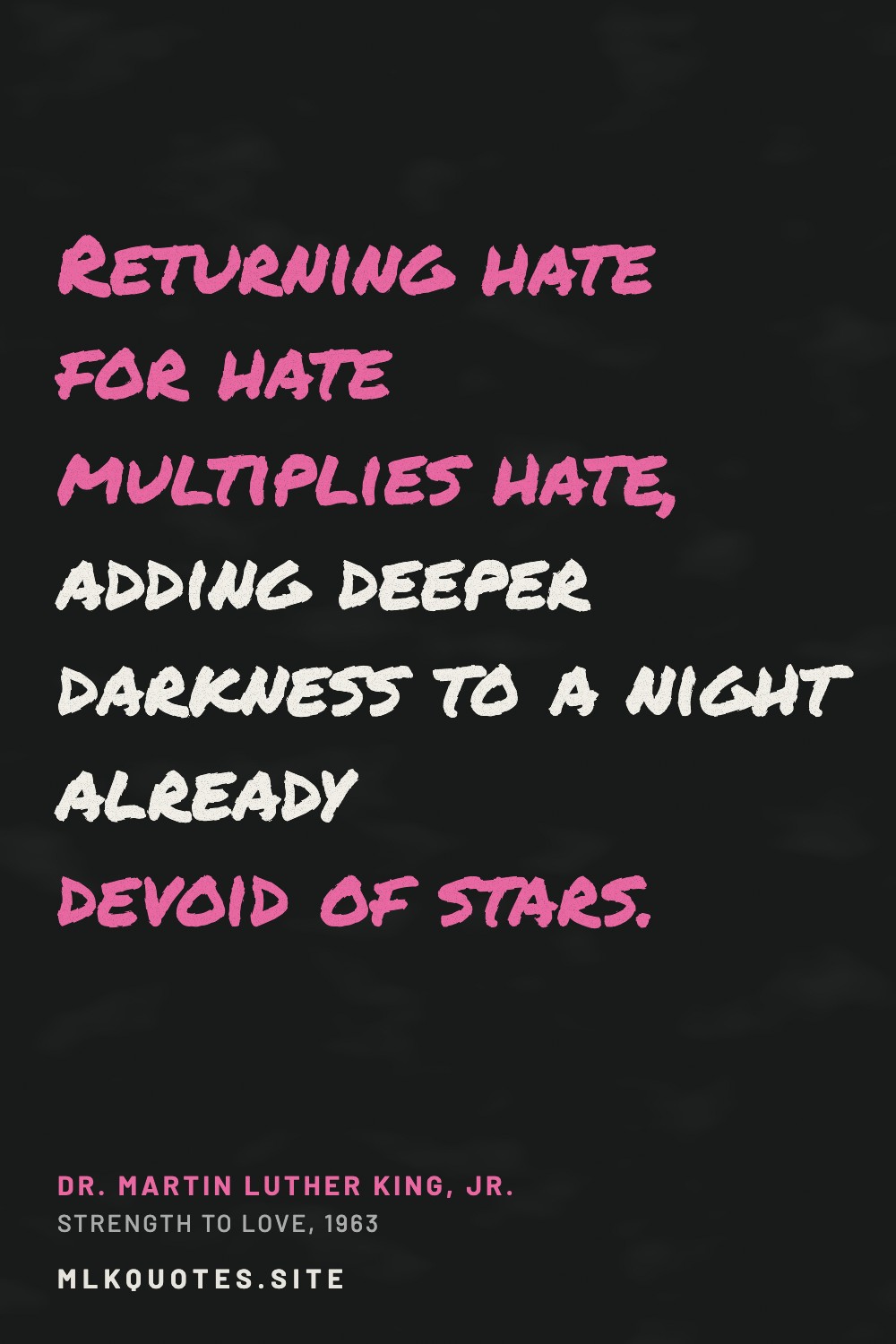
Quote image: “Returning hate for hate multiplies hate, adding deeper darkness to a night already devoid of stars.” Martin Luther King Jr., Strength to Love, 1963.

“Returning hate for hate multiplies hate, adding deeper darkness to a night already devoid of stars.”

Strength to Love, 1963

Save
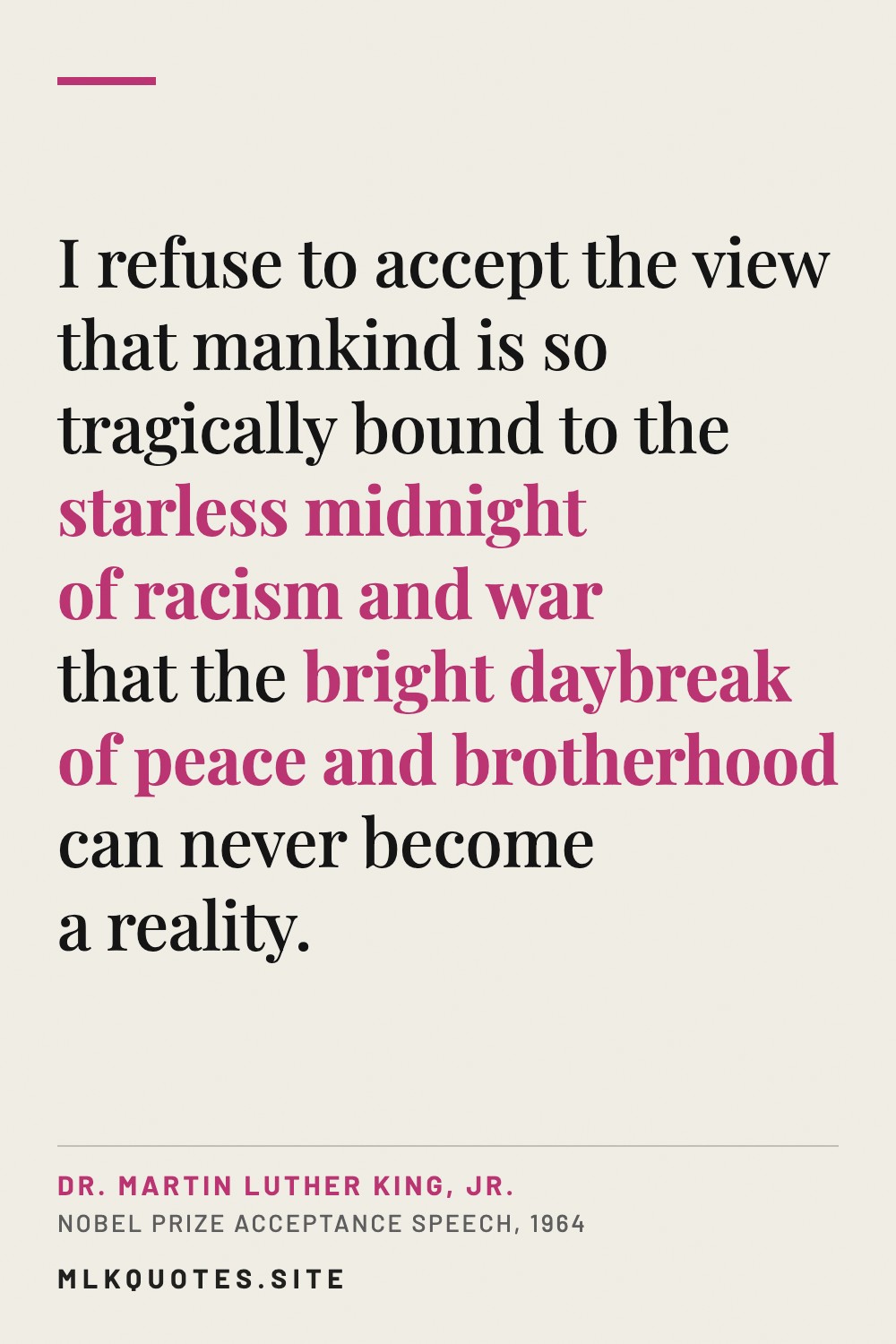
Quote image: “I refuse to accept the view that mankind is so tragically bound to the starless midnight of racism and war that the bright daybreak of peace and brotherhood can never become a reality.” Martin Luther King Jr., Nobel Prize acceptance speech, 1964.

“I refuse to accept the view that mankind is so tragically bound to the starless midnight of racism and war that the bright daybreak of peace and brotherhood can never become a reality.”

Nobel Prize acceptance speech, 1964

Save
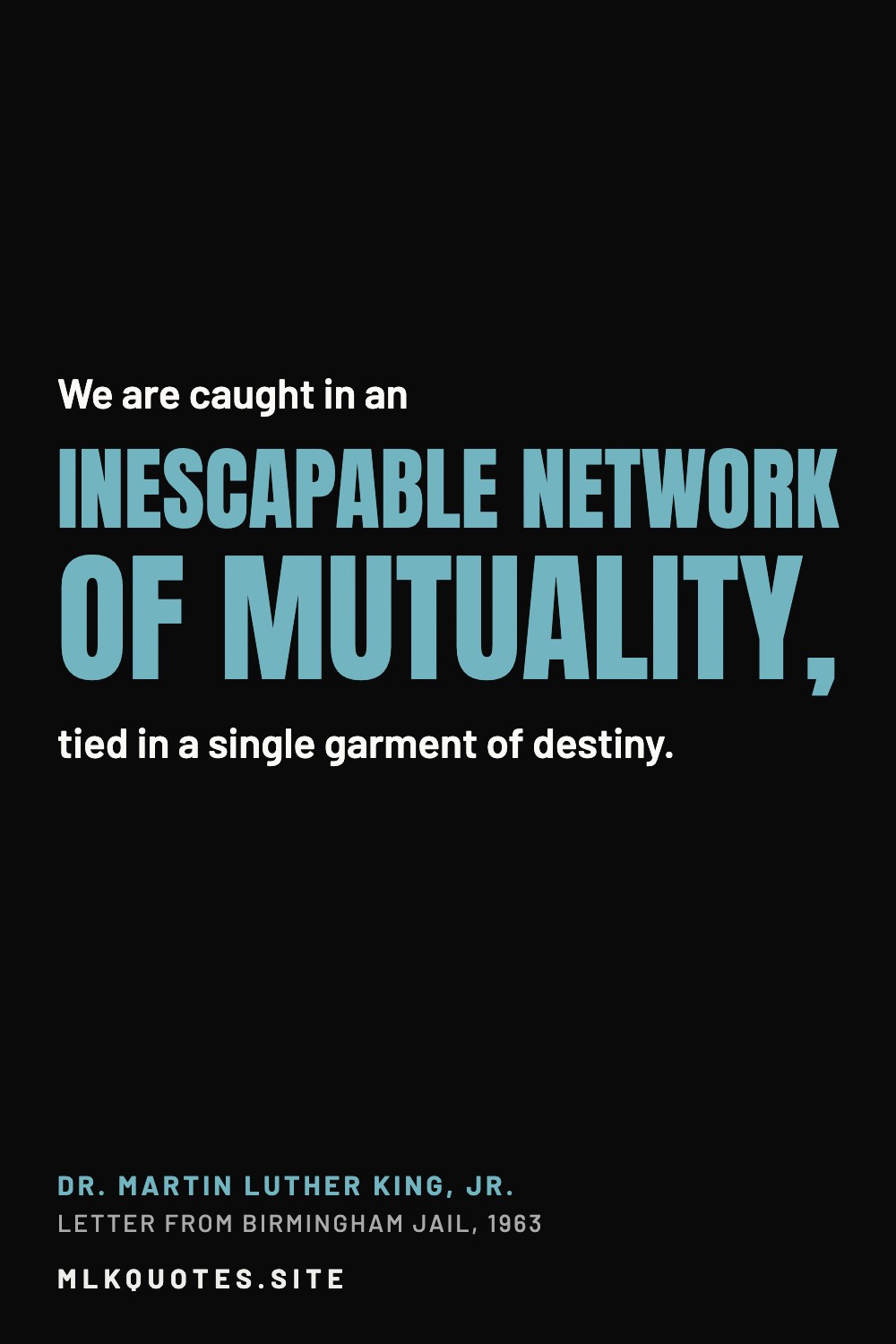
Quote image: “We are caught in an inescapable network of mutuality, tied in a single garment of destiny.” Martin Luther King Jr., Letter from Birmingham Jail, 1963.

“We are caught in an inescapable network of mutuality, tied in a single garment of destiny.”

Letter from Birmingham Jail, 1963

Save
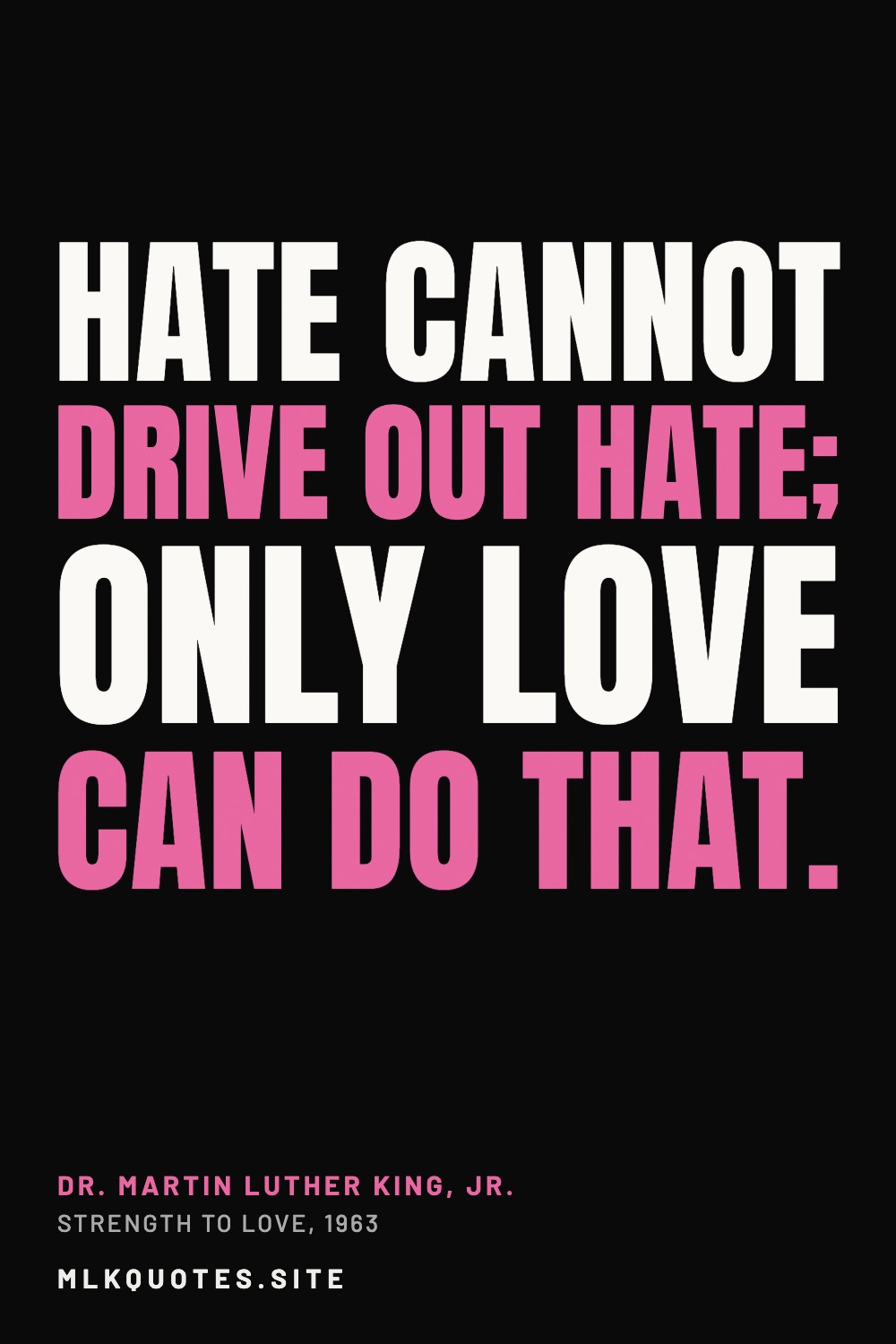
Quote image: “Hate cannot drive out hate; only love can do that.” Martin Luther King Jr., Strength to Love, 1963.

“Hate cannot drive out hate; only love can do that.”

Strength to Love, 1963

Save
Quote image: “We must develop and maintain the capacity to forgive. He who is devoid of the power to forgive is devoid of the power to love.” Martin Luther King Jr., Strength to Love, 1963.

“We must develop and maintain the capacity to forgive. He who is devoid of the power to forgive is devoid of the power to love.”

Strength to Love, 1963

Save
Quote image: “Peace is the presence of justice, the presence of brotherhood and unity.” Martin Luther King Jr., Speech, 1958.

“Peace is the presence of justice, the presence of brotherhood and unity.”

Speech, 1958

Save
Quote image: “Every man must decide whether he will walk in the light of creative altruism or in the darkness of destructive selfishness.” Martin Luther King Jr., Strength to Love, 1963.

“Every man must decide whether he will walk in the light of creative altruism or in the darkness of destructive selfishness.”

Strength to Love, 1963

Save
Quote image: “Power without love is reckless and abusive, and that love without power is sentimental and anemic.” Martin Luther King Jr., Where Do We Go From Here? (SCLC address), Atlanta, 1967.

“Power without love is reckless and abusive, and that love without power is sentimental and anemic.”

Where Do We Go From Here? (SCLC address), Atlanta, 1967

Save
Quote image: “The nonviolent resister does not seek to defeat or humiliate the opponent, but to win his friendship and understanding.” Martin Luther King Jr., Stride Toward Freedom, 1958.

“The nonviolent resister does not seek to defeat or humiliate the opponent, but to win his friendship and understanding.”

Stride Toward Freedom, 1958

Save
Quote image: “At the center of nonviolence stands the principle of love.” Martin Luther King Jr., Stride Toward Freedom, 1958.

“At the center of nonviolence stands the principle of love.”

Stride Toward Freedom, 1958

Save
Quote image: “We must all learn to live together as brothers or we will all perish together as fools.” Martin Luther King Jr., Oberlin College commencement address, 1965.

“We must all learn to live together as brothers or we will all perish together as fools.”

Oberlin College commencement address, 1965

Save
Quote image: “Man must evolve for all human conflict a method which rejects revenge, aggression, and retaliation. The foundation of such a method is love.” Martin Luther King Jr., Nobel Prize acceptance speech, 1964.

“Man must evolve for all human conflict a method which rejects revenge, aggression, and retaliation. The foundation of such a method is love.”

Nobel Prize acceptance speech, 1964

Save
Quote image: “Everybody can be great, because everybody can serve. … You only need a heart full of grace, a soul generated by love.” Martin Luther King Jr., The Drum Major Instinct, 1968.

“Everybody can be great, because everybody can serve. … You only need a heart full of grace, a soul generated by love.”

The Drum Major Instinct, 1968

Save
Quote image: “I have also decided to stick with love, for I know that love is ultimately the only answer to mankind's problems.” Martin Luther King Jr., Where Do We Go From Here? (SCLC address), Atlanta, 1967.

“I have also decided to stick with love, for I know that love is ultimately the only answer to mankind's problems.”

Where Do We Go From Here? (SCLC address), Atlanta, 1967

Save
Quote image: “Darkness cannot drive out darkness; only light can do that. Hate cannot drive out hate; only love can do that.” Martin Luther King Jr., Strength to Love, 1963.

“Darkness cannot drive out darkness; only light can do that. Hate cannot drive out hate; only love can do that.”

Strength to Love, 1963

Save
Quote image: “Love is the only force capable of transforming an enemy into a friend.” Martin Luther King Jr., Strength to Love, 1963.

“Love is the only force capable of transforming an enemy into a friend.”

Strength to Love, 1963

Save
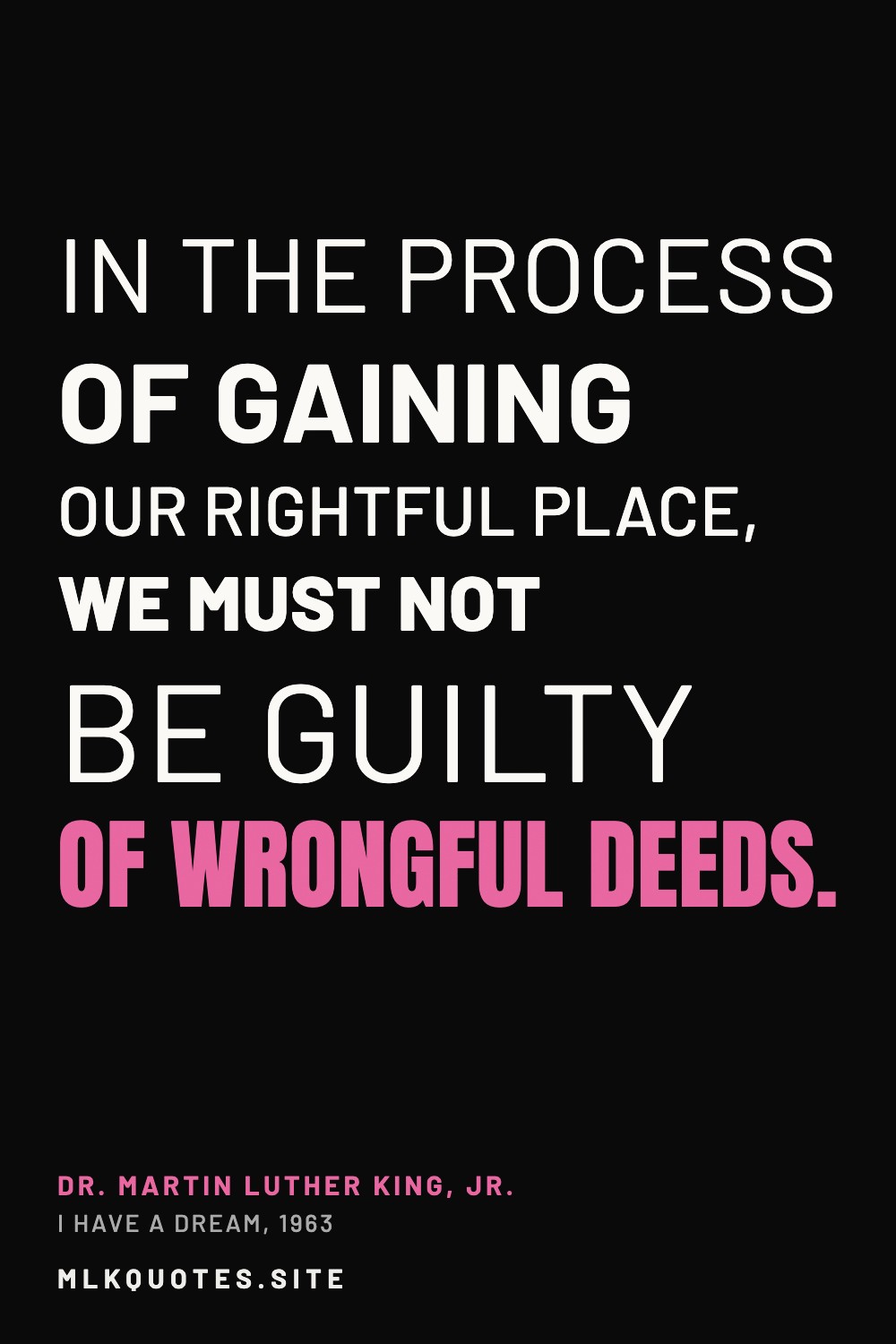
Quote image: “In the process of gaining our rightful place, we must not be guilty of wrongful deeds.” Martin Luther King Jr., I Have a Dream, 1963.

“In the process of gaining our rightful place, we must not be guilty of wrongful deeds.”

I Have a Dream, 1963

Save
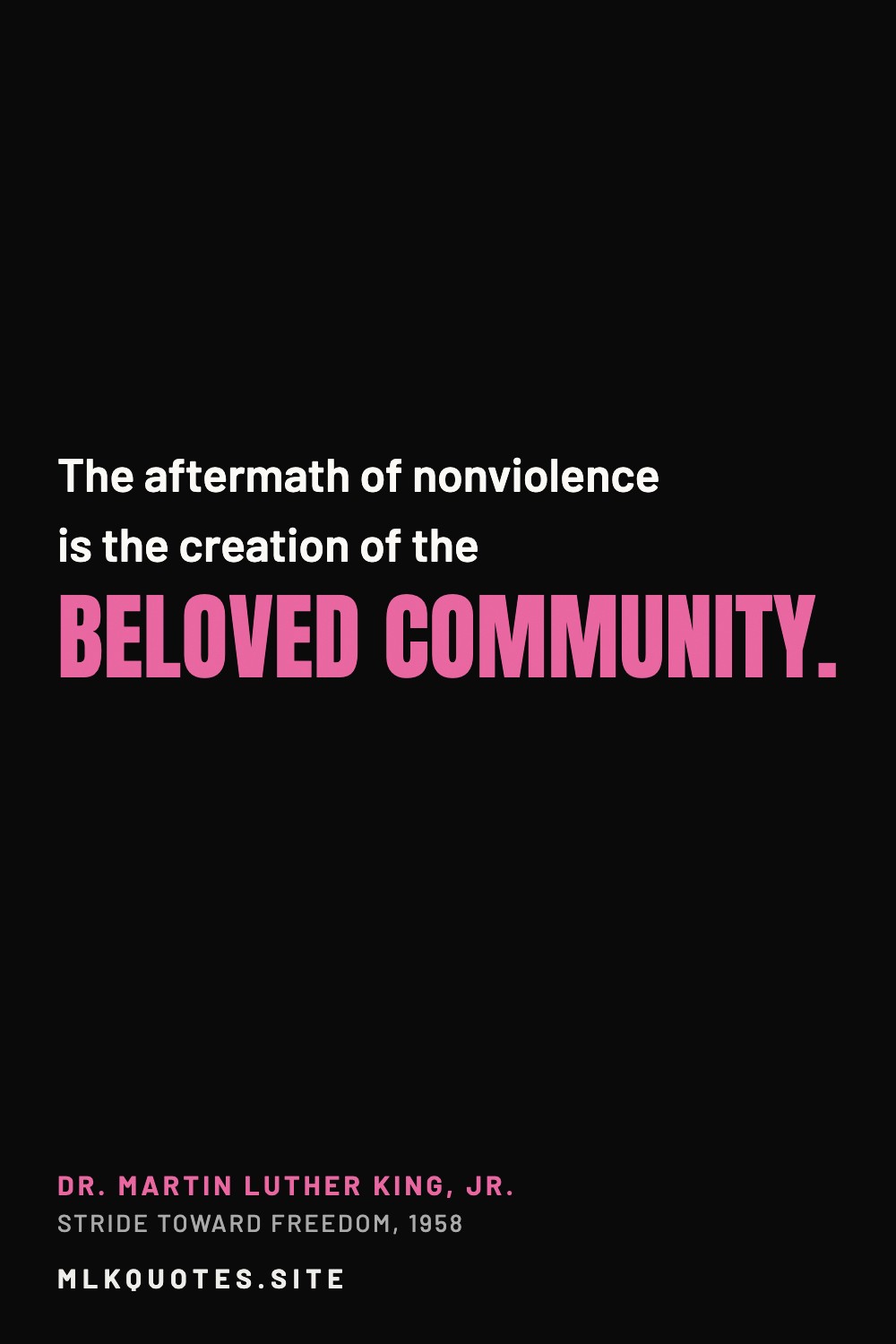
Quote image: “The aftermath of nonviolence is the creation of the beloved community.” Martin Luther King Jr., Stride Toward Freedom, 1958.

“The aftermath of nonviolence is the creation of the beloved community.”

Stride Toward Freedom, 1958

Save
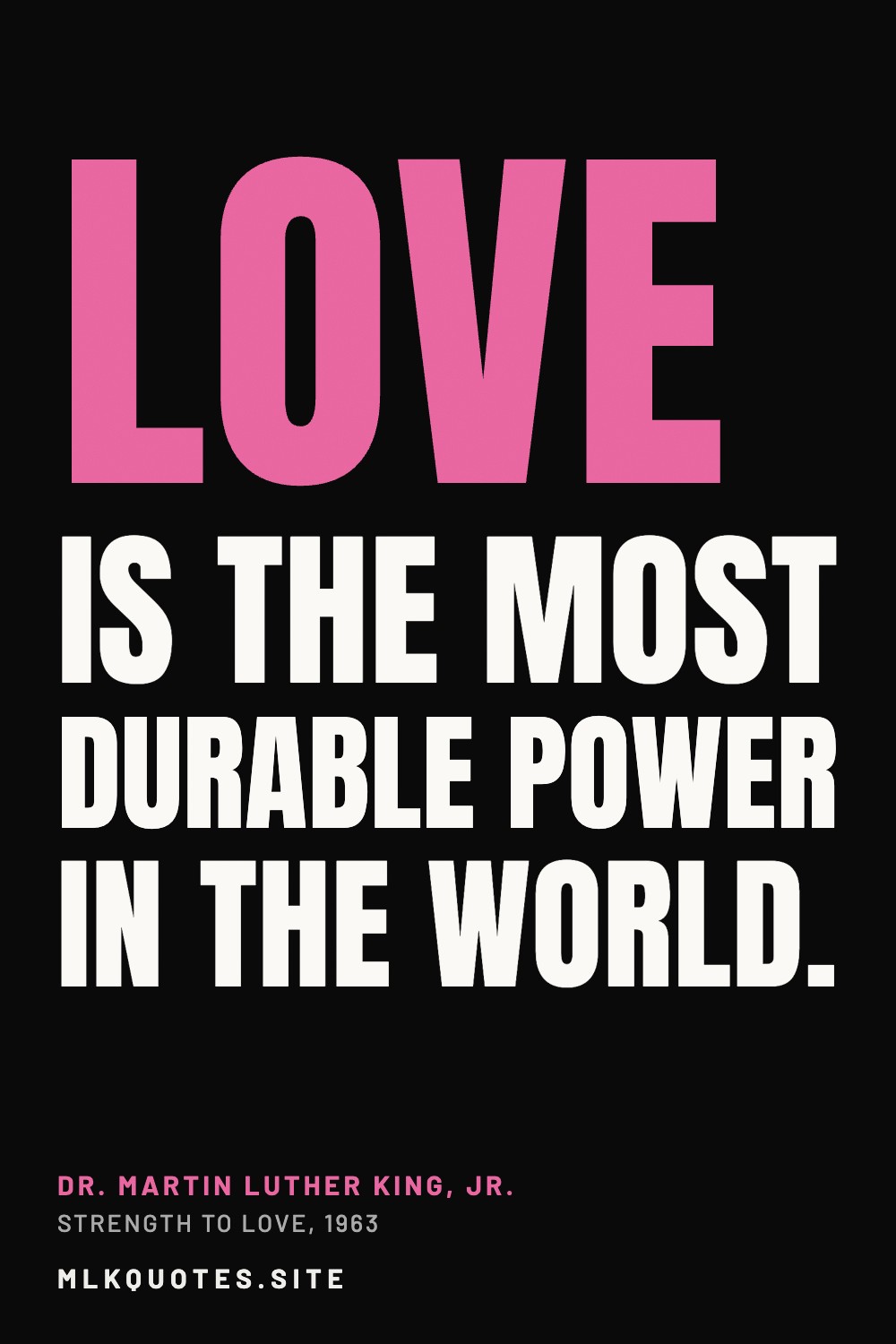
Quote image: “Love is the most durable power in the world.” Martin Luther King Jr., Strength to Love, 1963.

“Love is the most durable power in the world.”

Strength to Love, 1963

Save
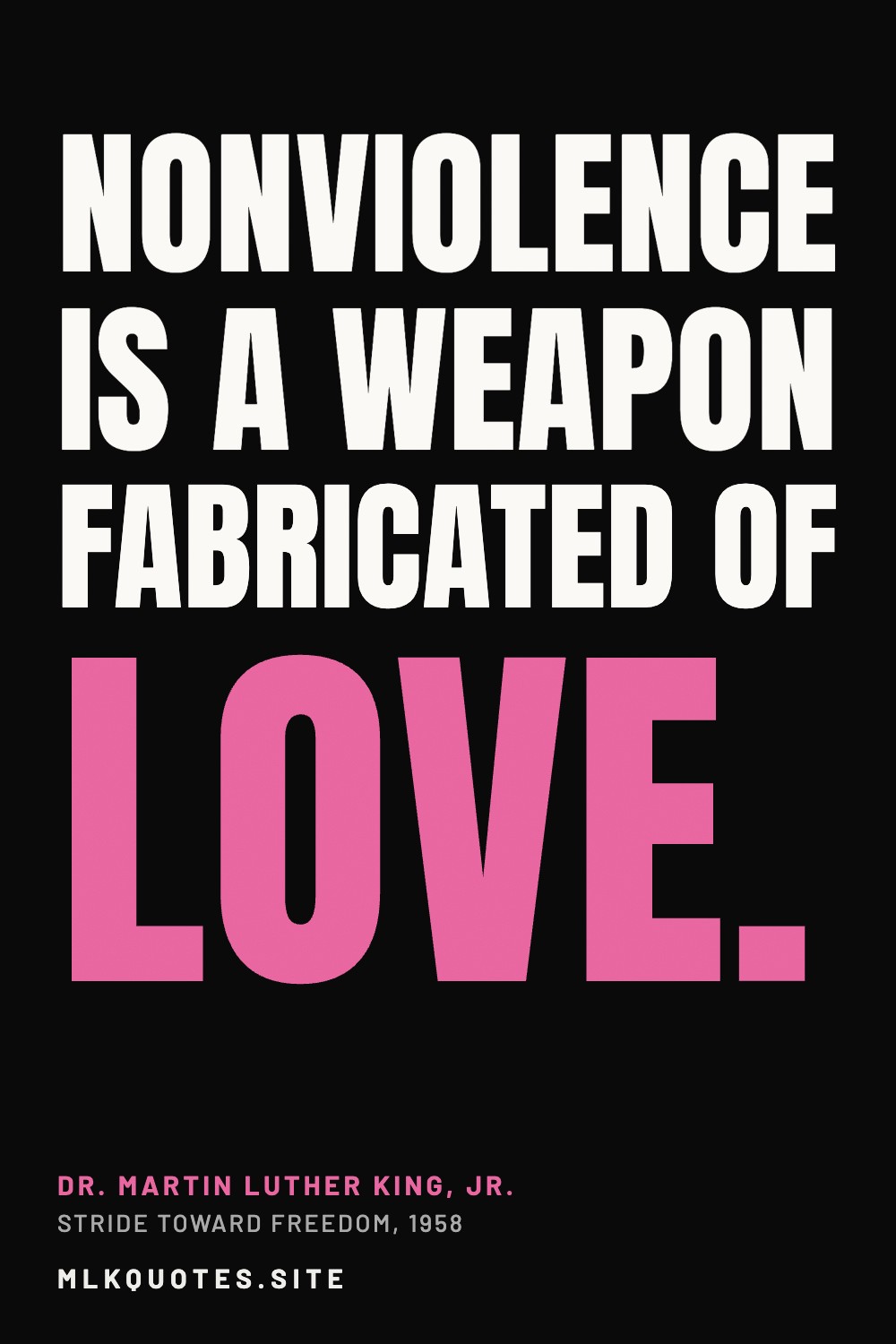
Quote image: “Nonviolence is a weapon fabricated of love.” Martin Luther King Jr., Stride Toward Freedom, 1958.

“Nonviolence is a weapon fabricated of love.”

Stride Toward Freedom, 1958

Save
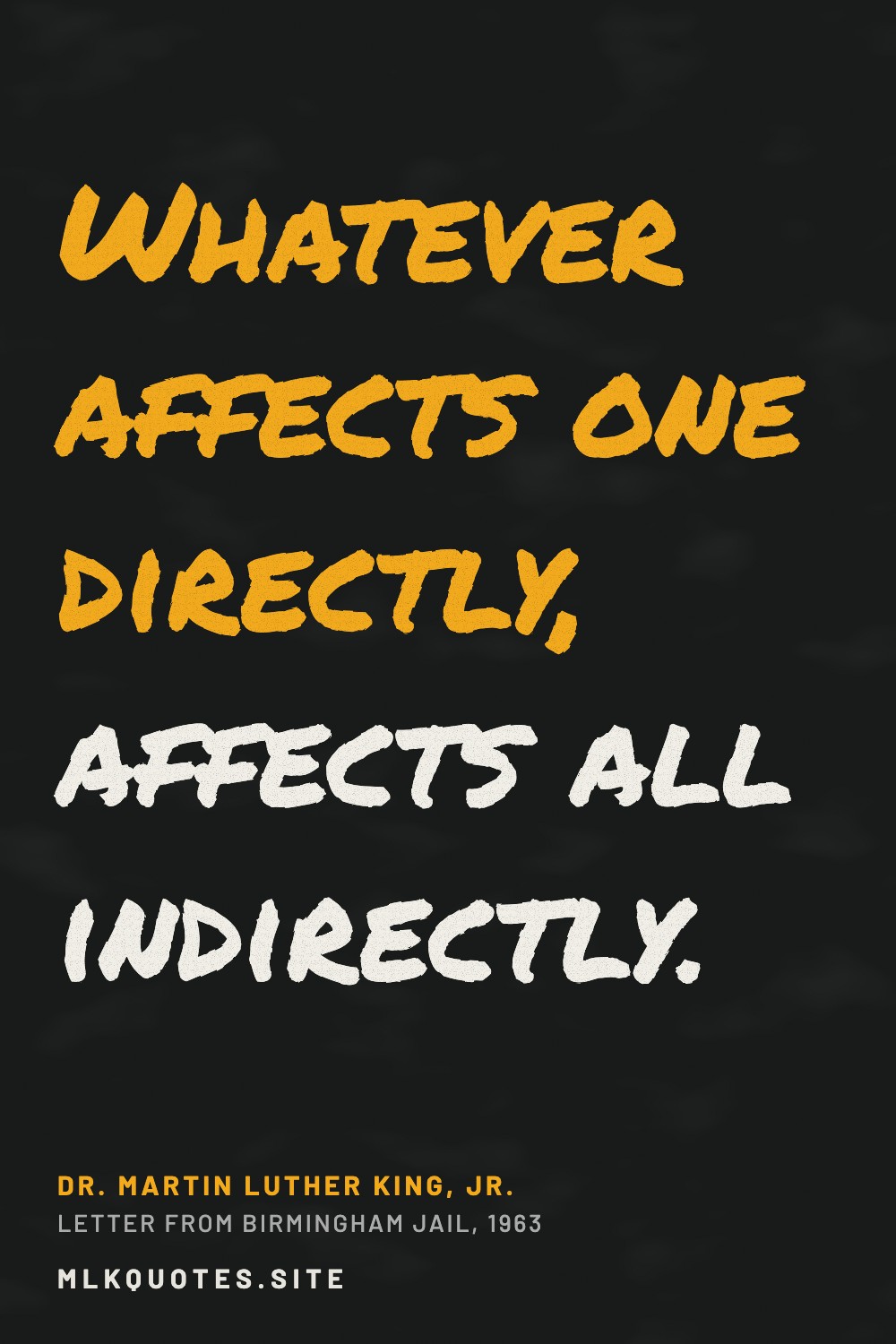
Quote image: “Whatever affects one directly, affects all indirectly.” Martin Luther King Jr., Letter from Birmingham Jail, 1963.

“Whatever affects one directly, affects all indirectly.”

Letter from Birmingham Jail, 1963

Save

Love as a method, not a mood

King kept returning to one word: agape. In a 1957 sermon at Dexter Avenue Baptist Church he separated it from romantic love (eros) and friendship (philia) and called it “something of the understanding, creative, redemptive goodwill for all men,” a love “that seeks nothing in return” (King Papers). He gave students at Spelman College nearly the same definition in 1960, and used it again in his Christmas Eve sermon broadcast by the CBC in 1967 (King Institute).

That consistency matters when you read his quotes. When King says “love,” he usually means a deliberate stance toward an opponent, not affection. It’s why love and nonviolence sit side by side in so many of the lines below.

When love was hard to defend

By 1967 the idea was under pressure, inside the movement and out. At the Southern Christian Leadership Conference’s tenth annual meeting in Atlanta that August, King told delegates he was sticking with it anyway, and that he knew it wasn’t a popular thing to talk about in some circles (King Institute). In the same speech he gave one of his sharpest definitions of the problem: “power without love is reckless and abusive, and that love without power is sentimental and anemic.”

Quoting these lines correctly

  • “Darkness cannot drive out darkness; only light can do that” comes from the 1963 book. In the 1967 speech he said “Darkness cannot put out darkness,” so the wording changed over time.
  • “I have decided to stick with love. Hate is too great a burden to bear” combines two separate passages of the 1967 speech. If you need an exact quote, use one sentence or the other.

Frequently asked questions

What did Martin Luther King Jr. say about love?

That love is a choice with consequences, not a mood. His most quoted line, “Hate cannot drive out hate; only love can do that,” appears in the sermon “Loving Your Enemies” in Strength to Love (1963). He argued that returning hate only multiplies it, so love is the only response that ends the cycle.

What is agape in King’s speeches?

Agape is a Greek word for love that King used to mean goodwill toward everyone, including enemies. He defined it almost identically for ten years: in his 1957 sermon “Loving Your Enemies” (“understanding, creative, redemptive goodwill for all men,” King Papers), at Spelman College in 1960, and in A Christmas Sermon on Peace in 1967.

Did MLK say “I have decided to stick with love”?

Yes. On 16 August 1967, addressing the Southern Christian Leadership Conference in Atlanta, he said: “I have also decided to stick with love, for I know that love is ultimately the only answer to mankind’s problems” (King Institute text). The popular version adds “Hate is too great a burden to bear.” He did say that too, but earlier in the same speech, so the two sentences weren’t spoken together.

Where does “Hate cannot drive out hate” come from?

From the sermon “Loving Your Enemies” as published in Strength to Love (1963). King first preached the sermon at Dexter Avenue Baptist Church in Montgomery on 17 November 1957, but the transcript of that service doesn’t contain the famous line; the polished wording belongs to the book. Full story of this quote.

Sources

  1. King Institute — Strength to Love
  2. King Papers — “Loving Your Enemies,” Dexter Avenue Baptist Church, 17 November 1957
  3. King Papers — “Keep Moving from This Mountain,” Spelman College, 10 April 1960
  4. King Institute — “Where Do We Go From Here?”, 16 August 1967
  5. King Institute — The Trumpet of Conscience

How this page was made: written with AI assistance from the primary sources listed above.Every quotation and fact was checked against those sources by Maddy on 6 October 2026. How we verify · Last updated 6 October 2026